
How can Australia build more affordable homes? New ideas put forward at housing affordability forum.
A wider range of housing choices, a stronger role for government, different construction methods and new ways to finance home ownership are among the ideas being explored to address Australia’s housing affordability problem.
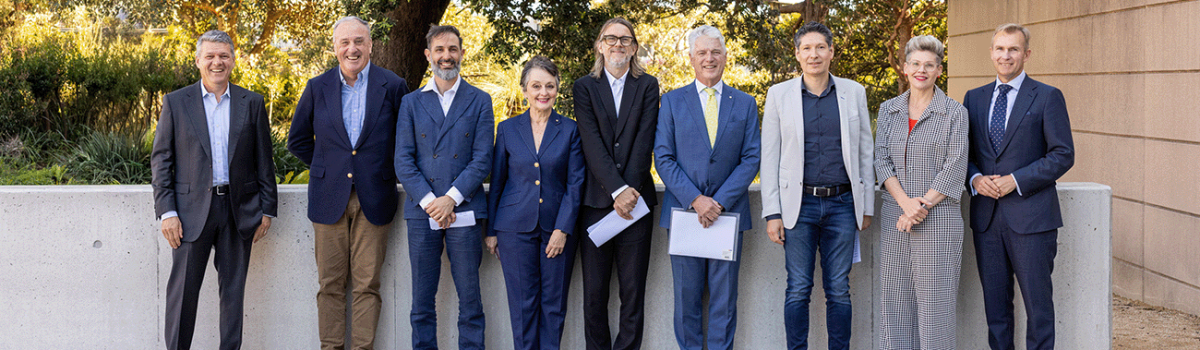
These issues were discussed by leaders from government, industry, finance and academia at a forum at the University of Sydney. The discussion was part of the inaugural event of the Martin Hill Public Program in Housing Affordability, established by HillPDA director Martin Hill AM as a five-year initiative.
The panel considered why so many working Australians are being priced out of home ownership, what can be learned from earlier approaches to public housing and what new models might help increase the supply of homes at prices more people can afford.
Reconsidering the role of public housing
Homes NSW CEO Rebecca Pinkstone highlighted the broader role public housing once played, when it accommodated working households as well as people on the lowest incomes.
She said that, particularly in the post-war period, public housing provided a platform for people to save and move into home ownership. Some bought their public housing property, while others went on to buy elsewhere.
“Public housing wasn’t targeted to the lowest income people. It had a broad base,” Pinkstone said.
“If they worked and they wanted to buy, sometimes they bought their public housing property out in the western suburbs of Sydney, and other times they went on to buy [in other areas]. People actually used public housing as a stepping point into home ownership. It wasn’t a targeted and residualised system that we have now that is 3.8% of the housing market.”
Asked whether Australia should return to that broader approach, Pinkstone agreed.
“I think we need to reimagine the role of the state in delivering housing of all types,” she said. “If we just purely rely on a market solution, we’ll be waiting for decades to come.”
New approaches to supply and delivery
Landcom CEO Alex Wendler spoke about the practical challenges of delivering more homes, including high construction and labour costs, infrastructure requirements and the difficulty of making projects financially viable.
He outlined Landcom’s work on build-to-rent housing, affordable rental projects with community housing providers and prefabricated terraces. The organisation is also exploring more compact apartment designs, although these face financing, planning and market acceptance challenges.
“If we just continue doing it, we will not solve this crisis,” Wendler said. “We need to be innovative. We need to try new things out.”
He added that “it’s really feasibility that will drive the supply”.
Westpac Senior Economist Matthew Hassan said Australia was likely to miss the National Housing Accord target of 1.2 million new homes over five years by at least 200,000.
“It took 20 years for these problems to get to where they are today. So there are no quick fixes to this,” he said.
Hassan said the commercial viability of new housing projects was being affected by interest rates, construction costs and weaker market conditions. He argued that Australia needs additional providers and new forms of home ownership to help deliver housing that the private investor market was not supplying.
He also said proposals such as Hill’s Housing as Infrastructure model could potentially reduce project risk significantly, depending on the details, and that government could help with that.
Different products for different households
Anglicare Chief Advocacy Officer and former NSW Planning Minister Dr Rob Stokes, challenged the way the housing problem is framed. He asked whether Australia should see it as “a social problem that requires economic change”, rather than an economic problem requiring social change.
He argued that housing policy should support homes that meet people’s needs, including access to natural light, space, public transport, parks, schools and other services. Economics, he said, should help deliver those expectations rather than lower them.
Dr Stokes also supported the development of more housing products at different price points, with different tenures and designs.
“We need multiple solutions and multiple products,” he said. “If there are lots of products into the market at different price points with different tenures and different typologies, that’s a great thing.”
Riverview Group Managing Director David Maxwell discussed the challenges of delivering large-scale housing projects and testing alternative models, including rent-to-buy and shared equity. He said banks had been a major obstacle to some of these approaches.
“The banks have been problems with both those,” Maxwell said, explaining that lenders were concerned about the consequences for their brand if they had to foreclose on a property. “That’s been the biggest obstacle that I’ve seen in that particular space.”
University of Sydney Head of Urbanism Associate Professor Laurence Troy highlighted the need for more choice in how people access housing, including alternatives to home ownership.
“The key element here is one of choice,” he said. “There should be the possibility to chart different pathways according to your own circumstances.”
A proposal to test
Martin Hill AM outlined his proposed Housing as Infrastructure model. It would provide another pathway for people such as key workers who can afford mortgage repayments but cannot meet the upfront cost of buying a home.
The solution combines more modest home designs and efficient construction methods with government support and deferred payment of part of the land value. That amount would be paid when the property is sold, while the resale price would be linked to an index such as wages rather than unrestricted market growth, helping keep the home affordable for the next eligible buyer.
Hill said the model needed to be considered alongside other approaches and tested through a pilot.
The Martin Hill Public Program in Housing Affordability will bring together industry, finance, government and academia to examine ideas and encourage frank, evidence-based debate. Its aim is to help translate research and discussion into policy and practical strategies for improving housing affordability.
The panel discussion can be viewed online here